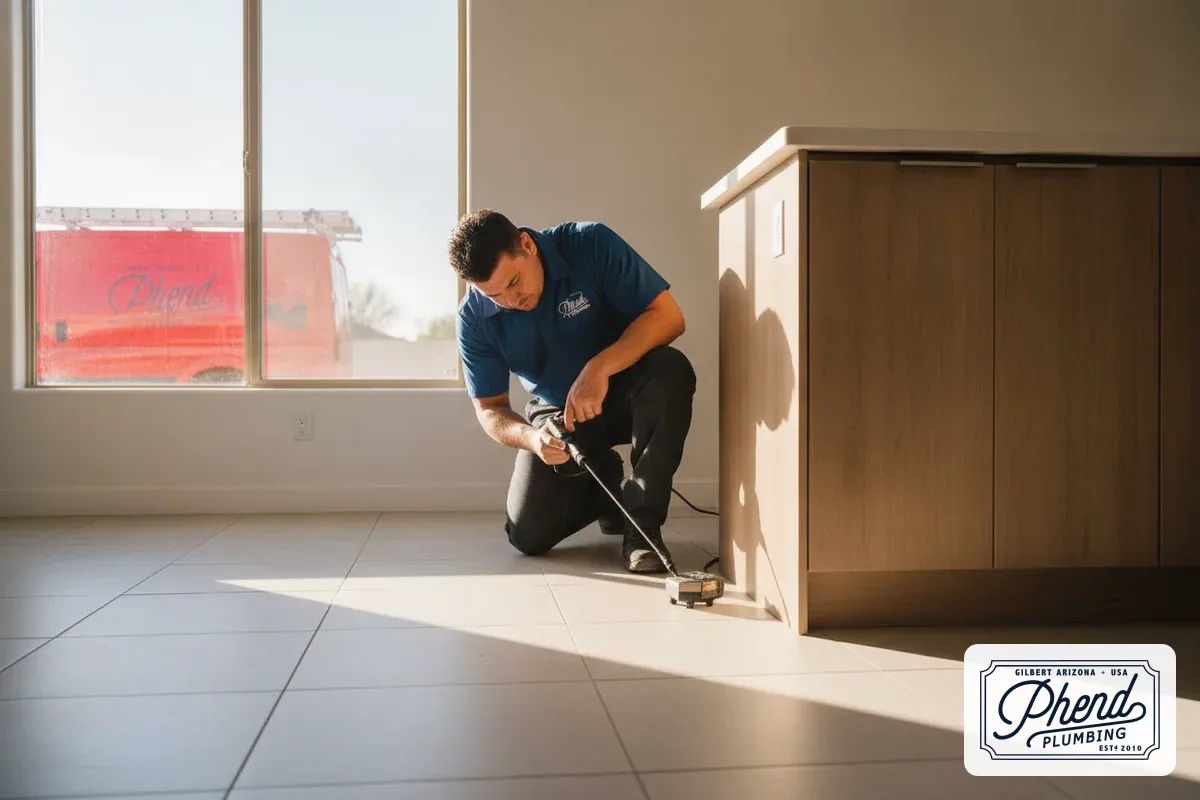
You step into the shower and notice the water is already pooling around your feet before you have even finished rinsing. The kitchen sink takes two full minutes to empty after you do the dishes. These are not just annoyances. They are your plumbing telling you something is wrong, and the longer you wait, the worse clogged drain repair gets. Whether the problem is a wad of hair in the P-trap or a partially blocked main sewer line, understanding what you are dealing with before you call anyone or grab a bottle of Drano can save you time, money, and a lot of frustration.
This guide walks you through exactly how to read those warning signs, figure out where the problem actually is, and decide when to handle it yourself versus when to call a licensed plumber. If you are in Tempe or anywhere in the East Valley, the local water conditions and soil add a layer to this that most generic plumbing articles never address. We will cover that too.
That Slow Drain Is Trying to Tell You Something: How to Read the Warning Signs
A drain that has gone from fast to slow did not do it overnight, even if it feels that way. The buildup happens gradually, and by the time you notice it, the restriction is already significant.
Here are the warning signs to pay attention to, in rough order of severity.
Water pooling or standing. If water sits in the shower pan or bathtub for more than 30 seconds after you stop running water, the drain is restricted. The slower the drain, the worse the blockage.
Gurgling sounds from other fixtures. When you flush the toilet and hear gurgling from the nearby bathroom sink, or you run the washing machine and the floor drain starts bubbling, that is a venting or main line issue, not a simple fixture clog. Do not ignore this one.
Odors coming from the drain. A sour or sulfur smell from a drain can mean trapped organic matter decomposing in a partial blockage, or it can signal a dry P-trap. Sewer gas smell is more serious and needs same-day attention.
Multiple slow drains at once. One slow drain in one bathroom is usually a localized problem. Two or more drains slowing down at the same time, especially in different parts of the house, points to the main sewer line.
Simple Clog vs. Deep Blockage vs. Main Line Problem: How to Tell the Difference
This is the single most useful diagnostic framework you can have as a homeowner, and almost no plumbing content explains it clearly.
A clog isolated to a single fixture (one shower, one bathroom sink, one kitchen drain) almost always means the blockage is in the P-trap or the branch drain line directly behind that fixture. These are usually within a few feet of the drain opening and are the most accessible to clear.
A slow drain that persists after you have cleared the P-trap, or a drain that clears temporarily and then clogs again within a few weeks, suggests the blockage is further down the branch line or at a junction point. A plumber’s snake can reach these, but a camera inspection is often the only way to see exactly what is happening.
When multiple fixtures are slow or completely stopped at the same time, or when sewage backs up into a lower fixture (like a ground-floor toilet or a floor drain) when you use an upper fixture, that is a main sewer line problem. This is the one that needs professional help right away. You can find more detail on the specific signs of a sewer line blockage in our article on 6 Signs That Your Sewer Line Is Clogged.
For Tempe homeowners specifically, tree root intrusion is worth keeping in mind. Established neighborhoods near Arizona State University and along the older streets closer to downtown Tempe have mature trees with aggressive root systems. Older clay or cast-iron sewer laterals in these areas are especially vulnerable. Roots seek moisture and can enter through the smallest pipe joint gap, causing recurring blockages that a simple snake clears temporarily before they grow back.
What Tempe Homeowners Should (and Should Not) Try Before Calling a Plumber
There is a reasonable middle ground between doing nothing and immediately calling for service. Here is what is worth trying yourself.
A cup plunger on sink and tub drains. A proper plunger with a good seal can dislodge a shallow P-trap clog in one or two minutes. Make sure you are using a cup plunger for flat drains, not a flange plunger (which is shaped for toilets). Cover the overflow opening on bathroom sinks with a wet rag before plunging so you get real suction.
A hand-operated drain snake for hair clogs. A basic 25-foot hand snake can reach the P-trap and several feet into the branch line. It is worth having one in the house. Our article Ask Pete: Can I Snake A Drain Myself? walks through how to do this without damaging your pipes.
Boiling or very hot water for grease clogs. On metal pipes only, hot water poured slowly down the drain can soften and flush grease buildup. Do not do this on PVC pipes.
What you should skip: chemical drain cleaners. Products like Drano generate a caustic chemical reaction inside your pipes. They can soften PVC, weaken older metal pipe joints, and they do absolutely nothing for mineral scale, which is a major contributor to slow drains in Tempe. The EPA’s WaterSense program also notes that slow or leaking drain fixtures left unaddressed can mask larger water waste issues, so getting a real diagnosis matters more than a temporary chemical fix.
If your own efforts clear the drain but the problem returns within a few weeks, stop repeating the same fix. Something structural is causing the recurring clog and it needs a camera inspection.
The Tools Professionals Use to Diagnose and Clear Drains in Tempe Homes
When you call a licensed plumber for clogged drain repair in Tempe, here is what the diagnostic and clearing process actually looks like.
Electric drain snake (also called a drain auger). A professional-grade motorized snake can reach 50 to 100 feet into a drain line and break through most organic blockages. It is effective for hair, grease, and some root intrusion, but it punches a hole through the clog rather than clearing the full pipe diameter.
Sewer camera inspection. A waterproof camera fed into the drain line gives the plumber a real-time view of the pipe interior. This is how you find out whether the blockage is scale buildup, root intrusion, a belly in the pipe, or a cracked joint. Without this, any repair is partly a guess.
Hydro-jetting. This is the most thorough drain cleaning method available. A hydro-jet uses high-pressure water streams up to 4,000 PSI to scour the full interior diameter of the pipe, removing grease, mineral scale, and even cutting through root intrusion. The National Association of Plumbing-Heating-Cooling Contractors (NAPHCC) recognizes hydro-jetting as the industry standard for thorough drain cleaning because it clears the pipe wall-to-wall rather than just opening a channel through the clog. For Tempe homes dealing with hard water scale, hydro-jetting often produces dramatically better long-term results than snaking alone.
Why Tempe’s Hard Water and Desert Soil Make Drain Problems Worse Over Time
This is the part that most generic drain cleaning articles skip entirely, and it directly affects how drain problems behave in your home.
The City of Tempe Water Utilities draws supply from the Salt River Project and local groundwater sources. The resulting municipal water supply is classified as very hard, typically running 12 to 20 grains per gallon. To put that in context, water above 7 grains per gallon is considered hard. Tempe’s water often comes in at nearly double that threshold.
Calcium and magnesium carbonate deposits coat the interior walls of drain pipes over time, narrowing the effective diameter and creating rough surfaces that catch soap scum, hair, and grease much more readily. A drain pipe that started at 1.5 inches in diameter can be functionally half that size after years of mineral scale accumulation, even if a snake inspection does not reveal an obvious blockage. This is why recurring slow drains are so common in Tempe and why the Arizona Department of Environmental Quality includes water hardness in its public water quality reporting framework.
Caliche soil, the calcium-rich hardpan layer common throughout the Phoenix metro, also plays a role in how exterior drain lines and sewer laterals behave. Caliche does not absorb water well, which means ground movement during monsoon season (July through September) can shift pipe alignments slightly over years, creating low spots or bellies where debris collects. If you have a recurring clog in the same drain line year after year, a camera inspection might reveal a belly caused by soil movement rather than anything you are putting down the drain.
What to Expect When You Call Phend Plumbing for Clogged Drain Repair in Tempe
We are a family-owned plumbing company based in Mesa and Gilbert, and we have been serving Tempe homeowners throughout the East Valley for years. When you call us for drain cleaning service in Tempe, here is what actually happens.
We start with a conversation. Before we touch anything, we ask you to describe what you are seeing: which fixtures are affected, how long the problem has been building, and whether you have tried anything yourself. That information shapes where we start.
We diagnose before we quote. If the problem is not obvious from a visual inspection, we recommend a camera inspection before recommending a fix. A camera takes 20 to 30 minutes and eliminates guesswork.
We clear the drain using the right tool for the actual problem. A hair clog in a shower P-trap does not need hydro-jetting. A main line packed with mineral scale and root intrusion does. We match the method to the diagnosis.
We explain what we found and what we recommend. If the camera shows a cracked pipe or root intrusion that will cause the same problem to return, we tell you that before you leave, along with your options.
Phend Plumbing holds Arizona Registrar of Contractors license #288046. You can verify any plumbing contractor’s license at the AZROC public license search portal before hiring anyone. This is a step most homeowners skip, and it matters. Unlicensed drain work can void your homeowner’s insurance coverage for related damage.
Call us at (480) 388-6093 to schedule a drain inspection or to talk through what you are seeing before you decide what to do next.
How Much Does Clogged Drain Repair Cost in Tempe, AZ?
We are not going to give you a number and call it a quote, because drain repair costs vary based on what is actually causing the problem. A simple snake-out of a single fixture costs far less than hydro-jetting a main line or repairing a cracked sewer lateral.
What we can tell you is that waiting almost always makes it more expensive. A partial blockage that a snake clears for a modest service call can become a hydro-jet job if left another six months. A slow main line that gets caught early is a cleaning. The same line left until sewage backs up into the house is a restoration job.
Call Phend Plumbing at (480) 388-6093 for a free estimate. We will give you a straight answer on what the job involves and what it will cost before we start any work. No surprises, no pressure.
You can also read more about drain cleaning and what the process involves on our service page, or check out the EPA’s guidance on household water efficiency for context on how unresolved drain issues connect to broader water use in Arizona’s drought-sensitive environment.
Based out of Mesa and Gilbert, we cover the full Phoenix metro, Phoenix, Gilbert, Scottsdale, and Queen Creek included. From drain cleaning and water heater service, every job comes with upfront pricing and no surprises. Reach us anytime at (480) 388-6093.